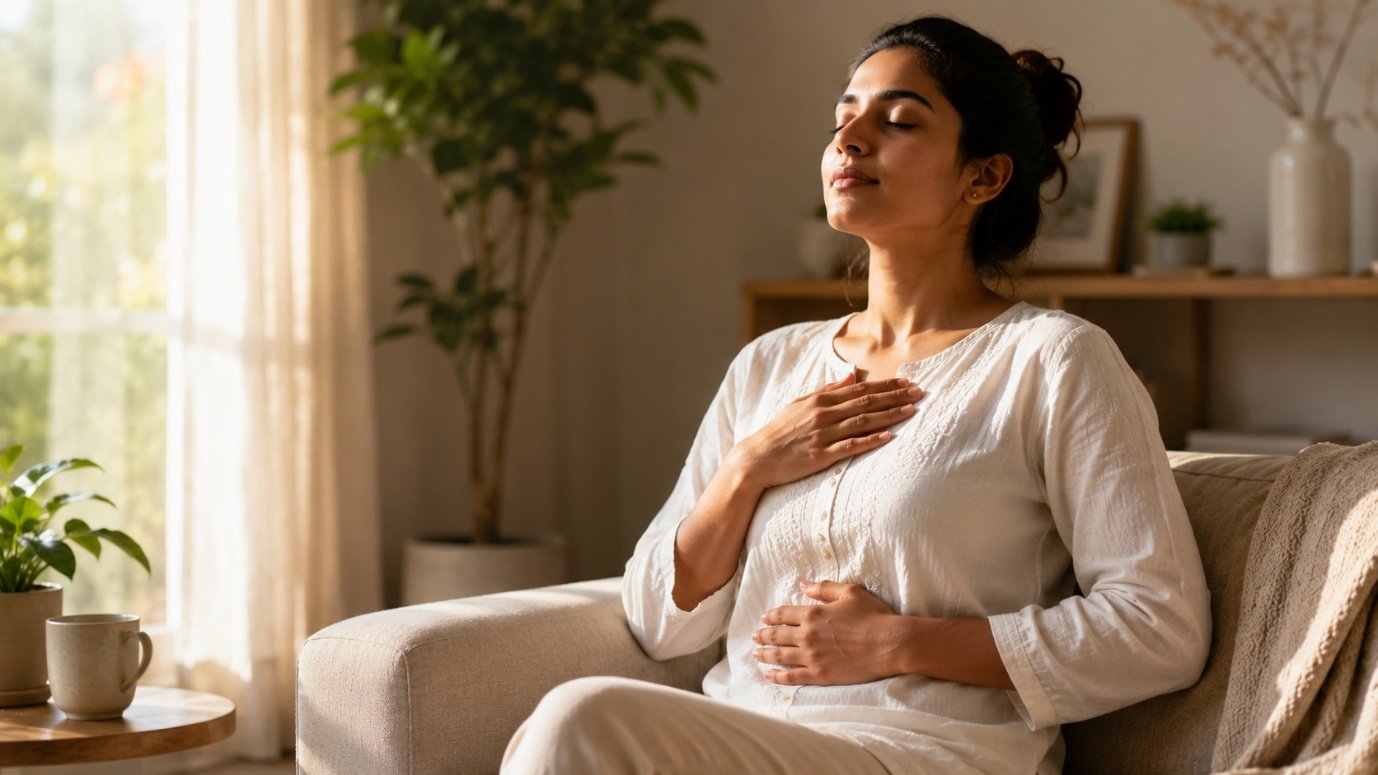
Stress rarely announces itself politely. It shows up mid-meeting, in traffic, in the middle of a conversation that's suddenly gone sideways, and in most of those moments, you don't have the option to step away for twenty minutes of meditation. What you do have, in literally every one of those moments, is your breath.
Breathing exercises are appealing precisely because of that. They're free, they're always available, and they don't require an app, a quiet room, or anyone else's cooperation. Here's a handful of simple techniques worth actually knowing, and when each one tends to help most.
Why breathing affects stress in the first place
Your breathing and your nervous system are directly linked. Quick, shallow breathing tends to go hand in hand with your body's stress response, the same one that shows up when you're anxious, rushed, or overwhelmed. Slower, deeper breathing does the opposite: it's associated with activating the body's calming response, the one responsible for winding things back down.
This is part of why "just take a deep breath" isn't just something people say to placate you. There's a real physiological reason it can genuinely help, though it works best when it's a real, slow breath, not just a quick sigh.
Box breathing
This is a favorite because it's simple to remember and easy to do discreetly, even at your desk or in a waiting room.
How to do it: Breathe in slowly for a count of four. Hold for a count of four. Breathe out slowly for a count of four. Hold again for a count of four. Repeat for four to six rounds.
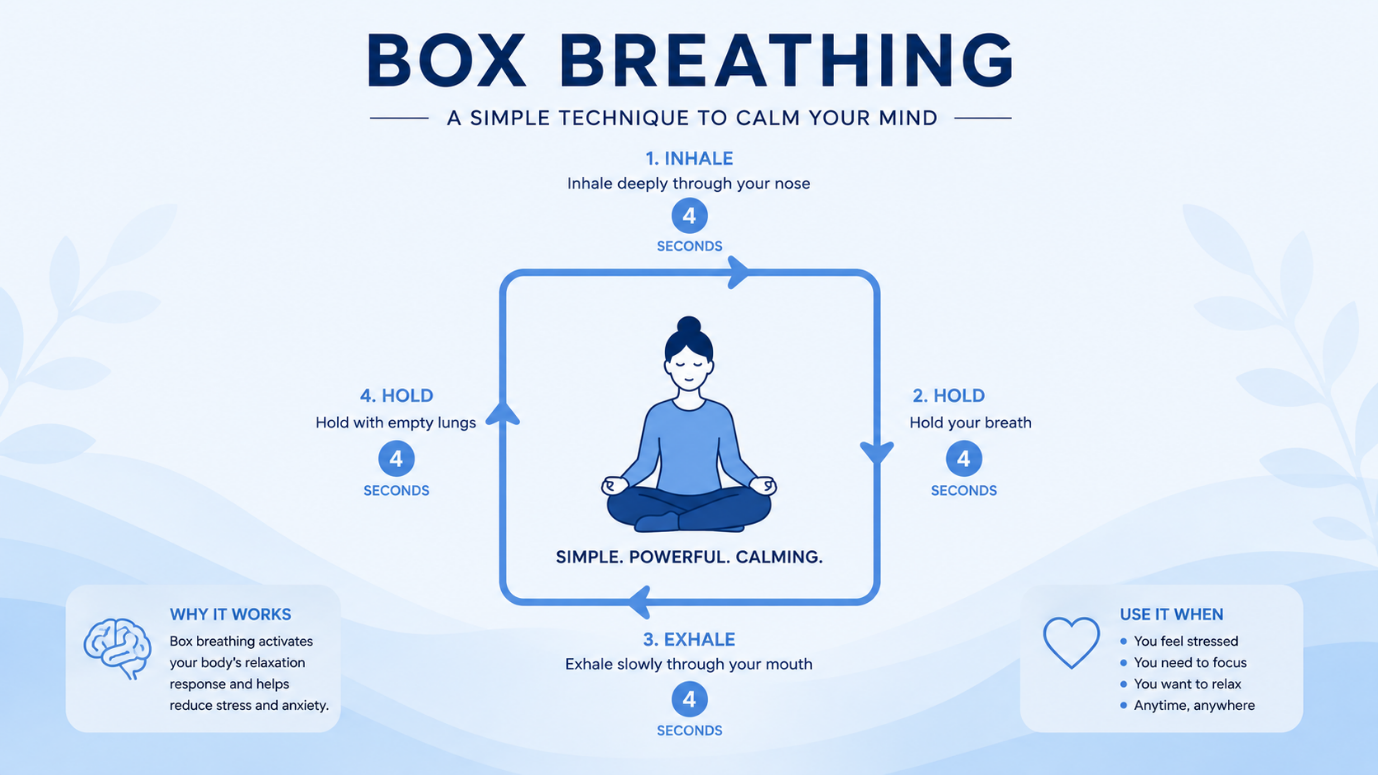
The equal counts on each side are what give it the "box" name, and the structure itself gives your mind something simple to focus on, which helps pull attention away from whatever's causing the stress in the first place.
Best for: A racing mind before a stressful conversation, presentation, or difficult email you're about to send.
The 4-7-8 technique
This one leans more heavily into the exhale, which tends to have a stronger calming effect than the inhale.
How to do it: Breathe in quietly through your nose for a count of four. Hold for a count of seven. Exhale slowly and completely through your mouth for a count of eight. Repeat for three to four rounds to start.
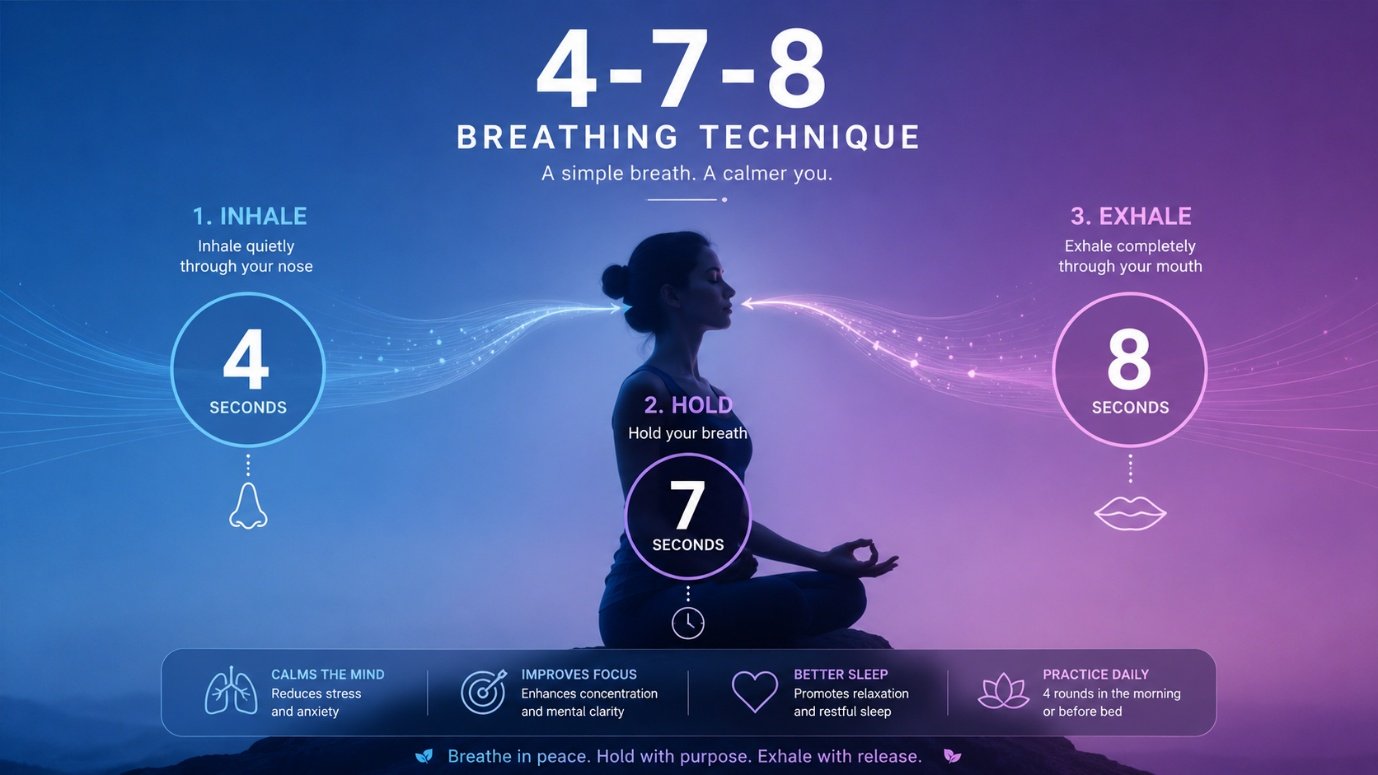
The longer exhale is doing most of the work here. If the counts feel like a stretch at first, shorter proportional counts, like 2-3.5-4, work just as well while you build up comfort with the pattern.
Best for: Winding down before bed, or in the middle of a moment that feels like it's spiraling and needs to be interrupted.
Physiological sigh
This one has become well known recently, and for good reason: it works quickly and doesn't require counting at all.
How to do it: Take a normal inhale through your nose, then, without exhaling, take a second short, sharp inhale on top of it. Follow with one long, slow exhale through your mouth. Repeat two or three times.
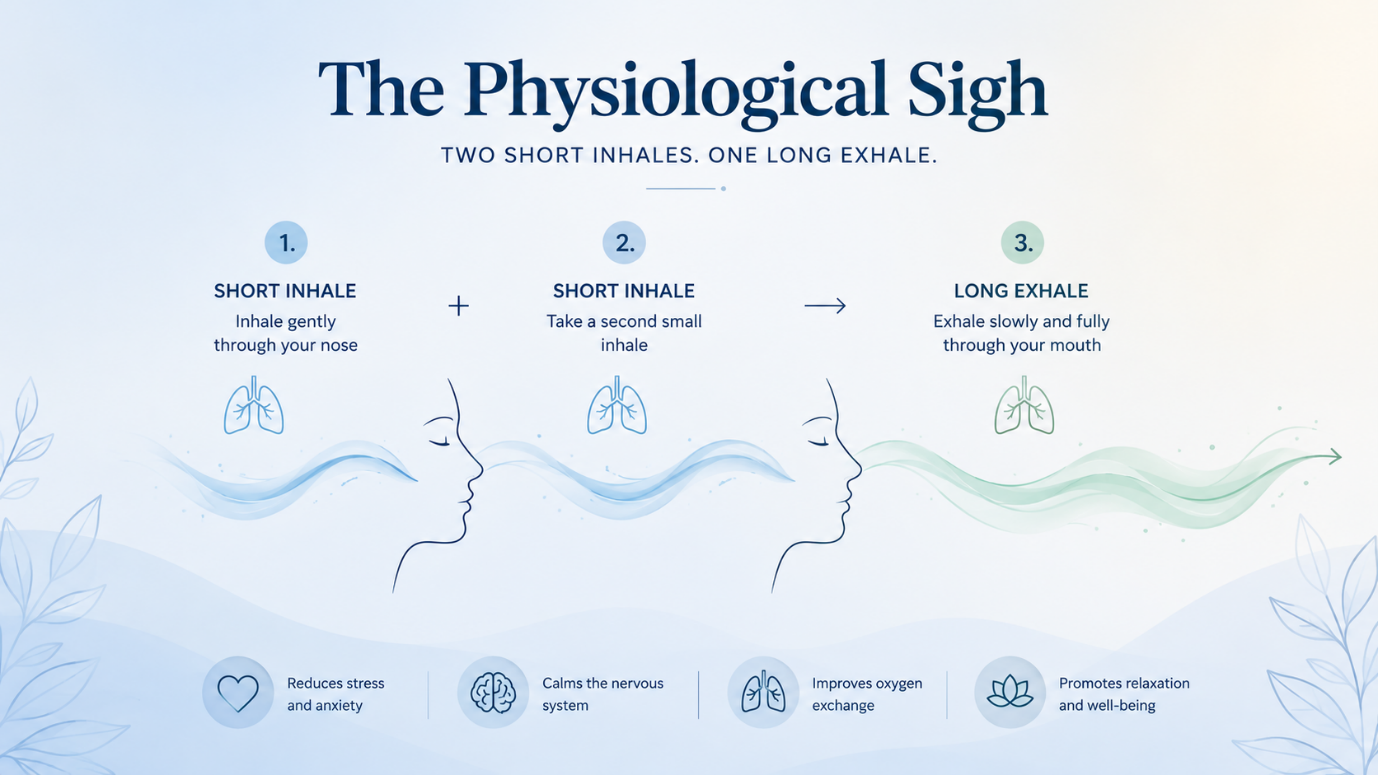
The double inhale helps reinflate small areas of the lungs that tend to collapse slightly during shallow, stressed breathing, and the long exhale that follows tends to produce a noticeably fast sense of relief.
Best for: An acute spike of stress, like right after a tense phone call or a startling piece of news, when you need something fast.
Extended exhale breathing
The simplest of the group, and a good starting point if counting feels distracting rather than calming.
How to do it: Breathe in normally, then exhale slowly, aiming to make the exhale roughly twice as long as the inhale. No strict counting needed, just a rough sense of a longer, slower out-breath.
Best for: Ongoing background stress throughout a busy day, since it's easy to do quietly without anyone noticing, even mid-conversation.
Making it an actual habit, not just an idea
Knowing these techniques and actually reaching for them in the moment are two different things. A few things help close that gap:
Practice when you're calm, not just when you're stressed. It's much easier to use a technique under pressure if it's already familiar, rather than trying to learn it for the first time in a stressful moment.
Pick one to start. Trying to remember four different techniques in the moment adds its own kind of stress. Choose one that appeals to you and practice it for a couple of weeks before adding another.
Attach it to something you already do. Try box breathing every time you're waiting for a page to load, or the physiological sigh right before opening your inbox. A consistent trigger makes it far more likely to become automatic.
Don't wait for a crisis to try it. Practicing during ordinary moments of mild stress, not just major ones, builds the habit so it's actually there for you when you need it most.
A quick note on limits
These techniques are genuinely useful for everyday stress, the kind that comes from a busy schedule, a difficult conversation, or a stressful moment at work. They aren't a replacement for professional support if you're dealing with ongoing anxiety, panic attacks, or a mental health condition. If stress feels like it's become a near-constant state rather than an occasional visitor, it's worth talking to a doctor or mental health professional, who can offer support beyond what any breathing exercise alone can provide.
For the everyday version of stress, though, the kind nearly everyone deals with regularly, your breath really is one of the most immediate tools you have. It's already with you. It just helps to know how to actually use it.



0 comments
Sign in to leave a comment.
No comments yet - be the first to share your thoughts.